Kitten vaccination schedule: shots by age and for adult cats
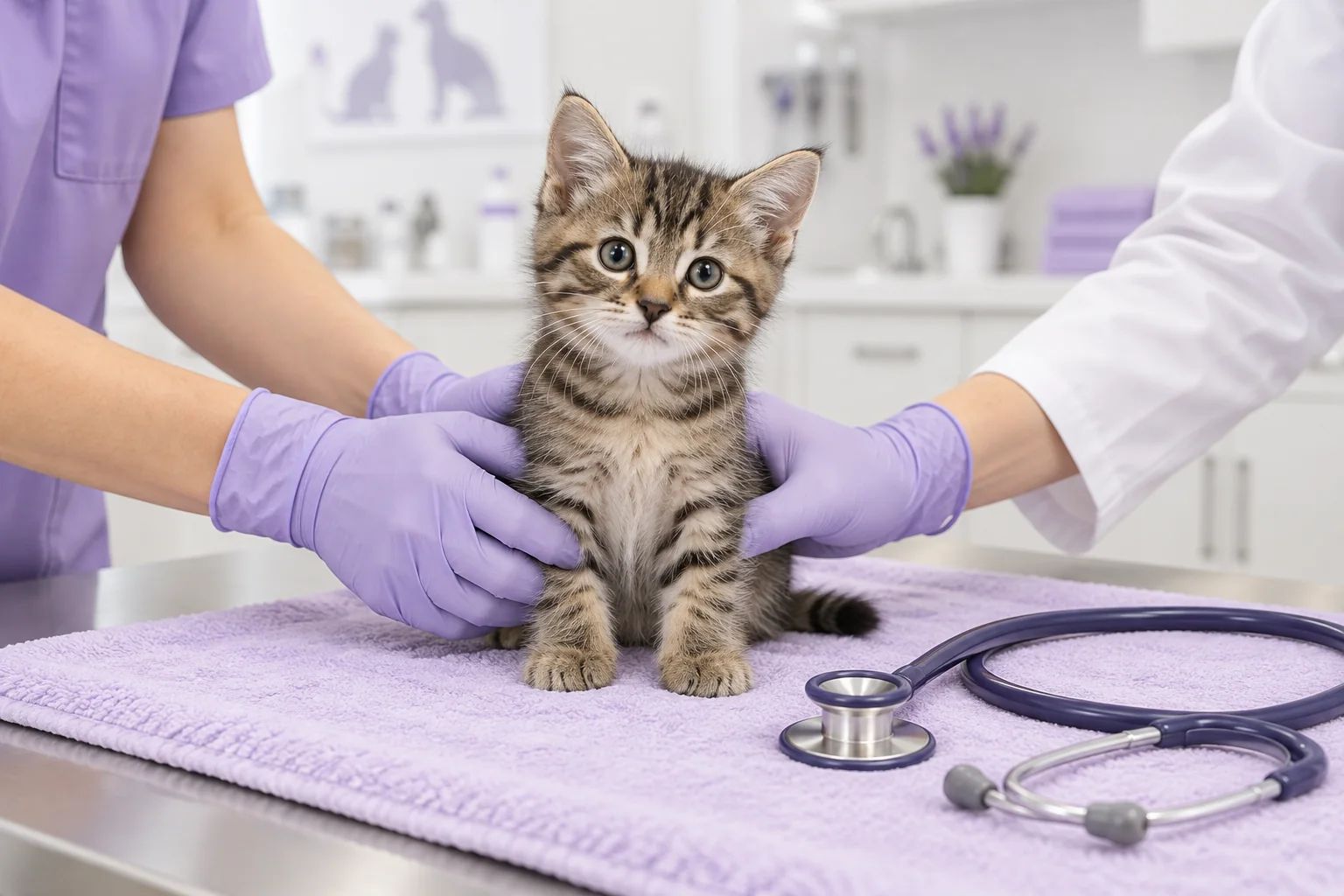
A kitten vaccination schedule starts at 6–8 weeks of age with the core vaccine against panleukopenia and cat flu. The kitten gets it again every 3–4 weeks until it is 16 weeks old or older, then once more at 6 months or a year; after that, most cats get it every 3 years. Feline leukemia is added for kittens and cats that go outside, and rabies where the law requires it. This is the typical schedule from the WSAVA and AAHA/AAFP vaccination guidelines; your vet sets the final schedule for your kitten.
| How you keep track of the next vaccine | Reminds you before it’s due | Each cat’s own dates | Record with batch numbers | All your pets together |
|---|---|---|---|---|
| Wagzy (coming soon) | Yes | Yes | Yes | Yes |
| Reminders from the clinic | If the clinic sends them | Yes | Kept at the clinic | Only that clinic’s pets |
| Phone calendar | If you set them | If you type them in | No | Mixed with everything else |
| Paper card from the vet | No | Yes | Usually | One card per cat |
Kitten vaccination schedule by age (chart)
An example with vaccines at 8, 12 and 16 weeks. Starting earlier or spacing the vaccines closer can mean an extra dose; the last kitten vaccine is given at 16 weeks or older. Your vet sets the dates.
| Age | Core vaccine (FVRCP) | Feline leukemia (FeLV) | Rabies |
|---|---|---|---|
| 8 weeks | 1st vaccine | 1st vaccine | — |
| 12 weeks | 2nd vaccine | 2nd vaccine, 3–4 weeks after the 1st | From 8–12 weeks, depending on the vaccine, where the law requires it |
| 16 weeks | 3rd vaccine, the last of the kitten series | ||
| Booster | At about 6 months (WSAVA, AAHA/AAFP) | 1 year after the 2nd vaccine | 1 year after the first rabies vaccine |
| After that | Panleukopenia: every 3 years or longer; herpesvirus and calicivirus: up to every year for cats at higher risk (WSAVA) | For cats at risk: yearly (WSAVA) or as the vaccine and your vet set it | Every 1 or 3 years, by law and vaccine |
- Why the vaccines repeat. A kitten gets antibodies from its mother, and until they fade they can block the vaccine. So the vaccines repeat until 16 weeks or later; for kittens at high risk, vets may continue to 20 weeks.
- The booster at 6 months or 1 year protects a kitten that didn’t respond to the earlier vaccines. WSAVA (2024) and AAHA/AAFP (2020) advise it at about 6 months rather than at 1 year.
- Feline leukemia is a core vaccine for kittens and cats under 1 year in the AAHA/AAFP guidelines, and in WSAVA’s where the virus is common: a kitten’s future lifestyle isn’t known yet. Later it continues for cats that go outside or live with cats that do. BSAVA in the UK advises the same: for cats under 1 year and older cats that go outside.
Core vaccines for cats and the optional ones
| Vaccine | Protects against | Who gets it |
|---|---|---|
| FVRCP | Feline viral rhinotracheitis (herpesvirus) and calicivirus — cat flu — and panleukopenia | Every cat: a core vaccine |
| FeLV | Feline leukemia virus | Kittens; then cats that go outside or live with cats that do |
| Rabies | Rabies | Core where rabies occurs; required by law in some places |
| Chlamydia, Bordetella | Respiratory infections | Cats in catteries and homes with many cats, if your vet recommends |
The letters on the record are explained in the cat vaccination record guide.
Cat vaccination schedule for adult cats
After the kitten series and the booster:
- Core vaccine (FVRCP): every 3 years for a cat at low risk — one that lives alone indoors and never stays in a cattery. A cat that boards, shows or lives with many cats may need the cat flu part every year (WSAVA).
- Feline leukemia: for cats that go outside or live with cats that do: yearly (WSAVA) or as the vaccine and your vet set it.
- Rabies: every 1 or 3 years, as the law and the vaccine require.
An adult cat with no record, such as a rescue, usually gets two core vaccines 2–4 weeks apart (WSAVA), plus rabies where required. Your vet decides what your cat needs.
Rabies for cats: what the law requires
- United States: set by each state. Many states, but not all, require cats to be vaccinated, usually by 3–6 months of age; the booster follows a year later, then every 1 or 3 years, depending on the vaccine and the state.
- Canada: set by provinces. In Ontario, cats must be vaccinated from 3 months of age, indoor cats included; the booster is due within a year, then every 1–3 years.
- UK: not part of the routine schedule; a cat gets it before traveling abroad.
- Australia: there is no rabies, so cats are vaccinated only to be exported.
Do indoor cats need vaccines?
Yes, the core ones. A cat that never goes outside can still meet viruses at the vet, in a cattery, from a new cat at home, or on your hands, shoes and clothes (AAHA/AAFP). In the UK, PDSA advises the cat flu and panleukopenia vaccines for all cats, indoor ones included. An indoor cat at low risk gets the core vaccine every 3 years. After the first year, feline leukemia is advised only for cats at risk: those that go outside or live with cats that do. Rabies follows the law, and in some places, such as Ontario, it covers indoor cats too.
Deworming in the first months
Kittens are dewormed on a schedule of their own, and the nursing mother is treated at the same time:
- US: from 2 weeks of age, every 2 weeks until 8 weeks, then monthly, year-round parasite control (CAPC).
- Canada: at 2, 4, 6 and 8 weeks, then monthly until 6 months (CPEP).
- UK and Europe: from 3 weeks, every 2 weeks until 2 weeks after weaning, then monthly until 6 months if an increased infection risk persists, for example if the kitten goes outside (ESCCAP).
These are reference schedules: your vet sets the final dates and intervals, chooses the product and decides how often your cat needs it as an adult. An indoor cat usually needs it less often than one that hunts outside.
Kitten vaccination schedule in the UK, Canada and Australia
UK
Kittens usually get two vaccines, at 9 and 12 weeks; some need a third at 15 weeks. The first booster comes a year later, then every 1–3 years (PDSA). On UK records the core vaccines are called cat flu and enteritis. Feline leukemia is advised for cats under 1 year and for older cats that go outside, even into a garden (BSAVA, PDSA).
Canada
The Canadian Veterinary Medical Association doesn’t publish its own schedule and refers vets to the published guidelines. The ages are the same as in the chart above; rabies follows the law of your province.
Australia
The Australian Veterinary Association groups vaccines as WSAVA does: panleukopenia, herpesvirus and calicivirus are the core ones, and on the record they are called F3. Feline leukemia, chlamydia and FIV vaccines are optional.
Keep your kitten’s vaccines on schedule
At each visit, ask when the next vaccine is due and write the date down. Keep the cat vaccination record — the printable above — with the vet’s certificates, and a photo of it on your phone. For medications, vet visits and weight, use a pet health record. Have a puppy too? See the puppy vaccination schedule.
Wagzy will remind you before each vaccine is due and keep every cat’s vaccines with the batch number, the expiry date and the vet’s certificates.
Frequently asked questions
When do kittens get their first shots?
At 6–8 weeks, then every 3–4 weeks until 16 weeks or older, with a booster at 6 months or 1 year.
How many shots does a kitten need?
Usually three or four core vaccines in the first months, depending on when the first one is given, then the booster. Add two feline leukemia vaccines if your vet advises them, and rabies where the law requires it.
How often do cats need shots?
After the first year, most cats get the core vaccine every 3 years; cats at higher risk may get the cat flu part every year. Cats that go outside also get feline leukemia boosters, and rabies follows the law: every 1 or 3 years.
Can an indoor kitten skip vaccines?
No. Core vaccines are advised for all cats, indoor ones included. In North America and the UK, feline leukemia is advised for kittens under 1 year too (AAHA/AAFP, BSAVA).
Sources
- WSAVA. 2024 guidelines for the vaccination of dogs and cats. Squires RA et al. Journal of Small Animal Practice, 2024.
- AAHA and AAFP. 2020 AAHA/AAFP Feline Vaccination Guidelines. Stone AES et al. Journal of the American Animal Hospital Association, 2020.
- BSAVA. Position statement on vaccination, 2026.
- PDSA. Cat and kitten vaccinations.
- AVA. Vaccination of dogs and cats.
- CVMA. Vaccination of animals, 2024.
- Animal Legal & Historical Center, Michigan State University. Table of state rabies laws concerning cats.
- Government of Ontario. Rabies vaccination for pets.
- GOV.UK. Taking your pet abroad.
- Department of Agriculture, Fisheries and Forestry (Australia). Rabies vaccination policy for the export of companion animals, 2022.
- CAPC. Ascarid guidelines, 2025.
- Canadian Parasitology Expert Panel. Guidelines for the management of parasites in dogs & cats.
- ESCCAP. Guideline 01: Worm control in dogs and cats, 7th edition, 2025.